
‘Bed bugs’ — just hearing the name conjures up a horrible nightmare: itchy bites and sleepless nights. But what happens if you leave your house empty for a long period? Can Bed Bugs survive, though? Here’s the surprising truth: bed bugs can stick around in an empty house. Even without a constant blood source, they’re quite resilient. This means that even vacant homes might need professional extermination before they’re safe to live in again.
However, the real question is, how long can bed bugs live without a host? That’s what we’re about to find out. Knowing this is crucial for effective control and eradication strategies.
So let’s explore.
How Long Can Bed Bugs Live Without a Host in London Properties?
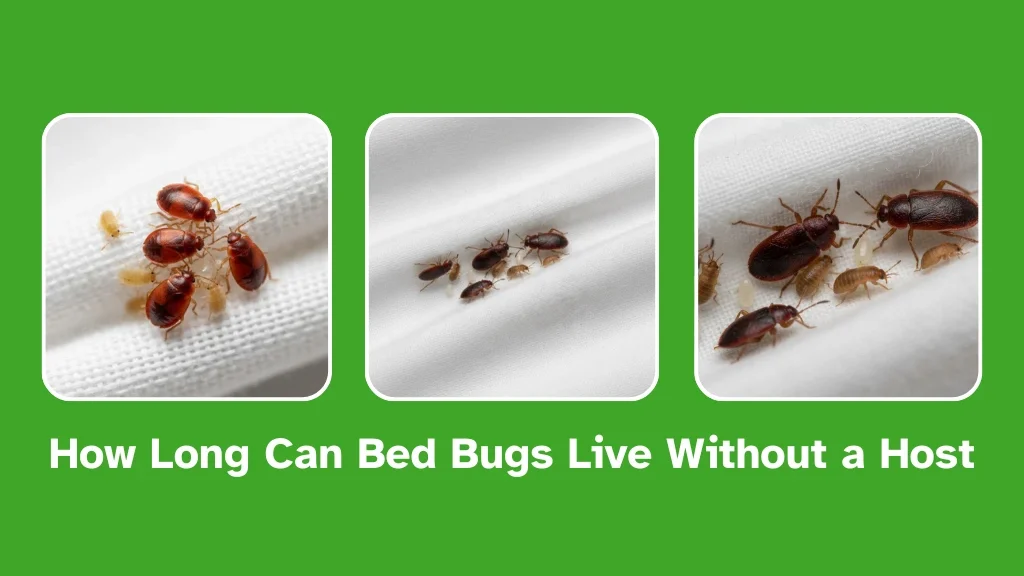
Bed bugs are notorious pests. Assume them as tiny vampires without those Dracula teeth. They commonly feed on human blood. Like vampires, bed bugs thrive on blood.
With resilience and adaptability, bed bugs stand out as a formidable vermin in London. They inhabit homes, offices, hospitals, schools, and dormitories. Curious about their survival? They can live quite a long time without feeding:
- Homes and residences: Up to a year or more, depending on humidity and temperature—perfect conditions for hibernation.
- In offices: Usually 3–6 months, as they often have less direct access to blood and may hide while waiting for humans or rodents.
- In hospitals: Up to a year or more, especially in less disturbed areas. They thrive where blood exposure is frequent near patients and medical equipment.
- In dormitories: Over a year. Dorm rooms provide conditions similar to homes for long-term survival.
How long can bed bugs live without food at different life stages?
Bed bugs have five life stages between moults. Immature bed bugs consume blood, shed exoskeletons, and grow continuously. Just as an adult human can survive longer without food than an infant, the same principle applies to bed bugs.
So, how long can bed bugs live without a host at different life stages? Here’s the answer:
Egg Stage: Bed bug eggs are viable for about 6-10 weeks before hatching. Once hatched, they need blood to molt and develop further.
Nymph Stage: Smaller, younger nymphs can last a few weeks without feeding, but as they get older, they can survive longer—up to 1-4.5 months.
Adult Stage: Adult bed bugs are the marathon runners of starvation. Under typical room conditions, adult bed bugs can live between 2 and 6 months or even a year. In cooler, ideal lab environments, they can survive from 99 days up to 400 days.
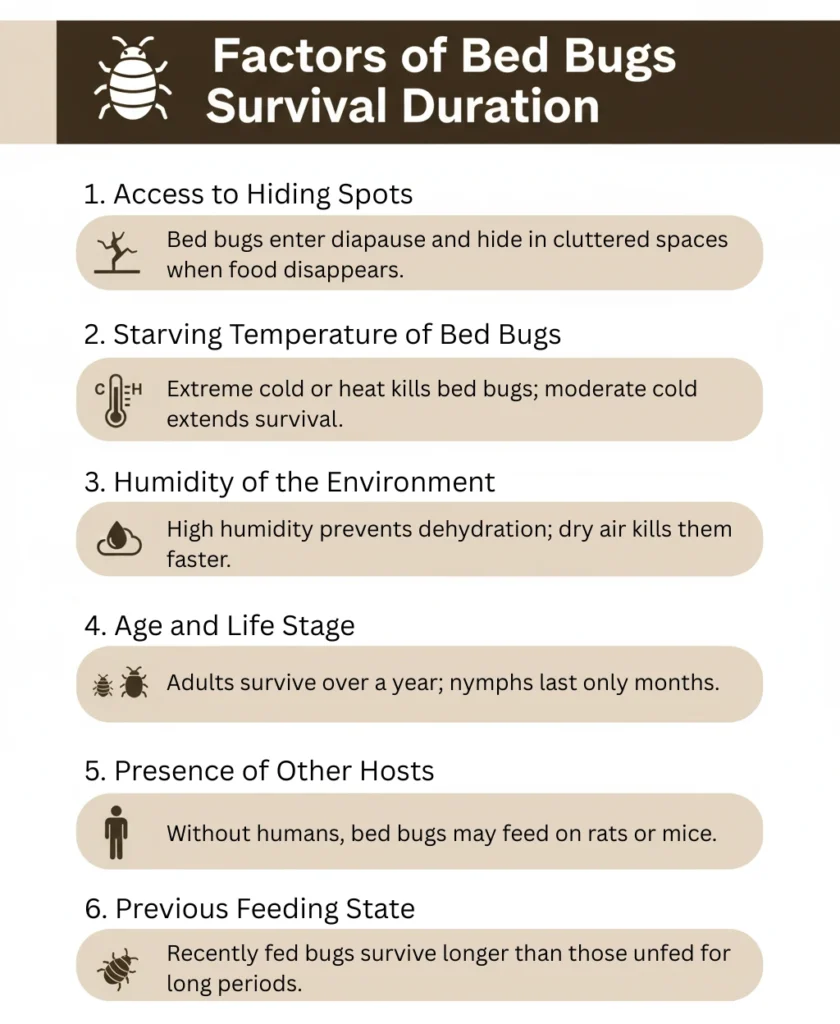
Key Influencing Factors: What can affect bed bugs’ survival duration?
No source of blood and bed bugs problem solved? It’s quite complicated. You’re vanishing the most stubborn pest on the planet. So, there is a huge but. Probably, you’re underestimating bed bugs—they are masters of survival. Still, a glimmer of hope exists: understanding the factors that influence bed bugs’ survival could be the key to controlling them.
Access to Hiding Spots:
When food sources disappear, bed bugs activate diapause, their survival superpower. They lower their metabolic rate and hide under clutter. Densely furnished London properties provide ample hiding spots where they can remain undetected.
Starving Temperature of Bed Bugs:
Cooler temperatures slow down bed bugs’ metabolism, allowing them to survive longer without feeding. Conversely, warmer temperatures reduce their chances of survival. Temperatures below 25°F (-4°C) or above 113°F (45°C) can be lethal to bed bugs.
Humidity of the Environment:
High humidity keeps bed bugs from drying out, since they rely solely on blood for hydration. Dry conditions dehydrate and kill them over time. Usually, dehydration kills bed bugs more often than starvation.
Age and Life Stage:
Nymphs are less resilient than adults because they need blood to progress to the next stage. Adults can survive for over a year without feeding, while nymphs typically last only a few months.
Presence of Other Hosts:
In the absence of humans, bed bugs may feed on rats or mice, which can prolong their life and increase their chances of reproducing.
Previous Feeding State:
A recently fed bed bug can survive longer than one that was fed earlier. The amount of blood they’ve recently consumed affects their survival, especially for nymphs.
How do bed bugs live without a host for a long time?
Bed bugs have an incredible biological trick for their sleep: diapause. It’s nearly impossible to starve them when they enter this hibernation-like state. Diapause is their secret weapon for surviving without feeding. So, how do bed bugs live longer without a host?
- Go dormant until the host returns.
- Starve in cooler temperatures. Cooler temperatures lower their metabolic rate and slow down activity, helping them survive longer.
- Choose dark, low-exposure, humid areas. High humidity prevents dehydration.
- Hide under clutter, in crevices, under floors, or folds to conserve moisture.
- Find another host, such as mice or rats, for a quick snack.
- Migrate to neighboring houses through vents, door gaps, etc., to find a new host.
How to spot bed bugs in an empty house?
A passive approach might be doomed when dealing with bed bugs. After all, they are highly resilient. Should you step back? Not really. Letting bed bugs starve isn’t the solution because your pest problem can escalate into a building-wide crisis. So, focus on recognizing their signs to spot them, even in an empty house—especially in hiding spots. Look for these clues:
■ Reddish or rusty stains: Blood or crushed bed bugs’ remains, often found on bedding, mattress edges, or near hiding spots.
■ Dark spots: Tiny black or dark brown fecal spots—about 1mm—usually in mattress creases, behind picture frames, or inside furniture cracks.
■ Moulting shells: Shedded skins that are pale yellow or translucent, typically in cracks, under furniture, or in seams.
■ Eggs and eggshells: Tiny, about 1mm, pale yellow or white eggs that tend to stick to fabric or hide in cracks, often clustered.
■ Live bugs: Small, light brown or golden brown insects, usually 4-5mm, often in hiding or dormant, but active at night or when disturbed.
Common Hiding Places: Where do bed bugs live in a house?
Bed bugs are incredible masters at hiding. They tend to stick close to human sources like beds, sofas, and mattresses, but they can also hide elsewhere where people spend a lot of time. Here are some common hiding spots to keep an eye on:
Gaps and Cracks: Check for cracks in walls, along skirting boards, behind wallpaper, tiny holes, and gaps around door and window frames, as well as carpet edges.
Electric Appliances: Bed bugs often hide in warm spots or crevices of electrical devices. Look inside sockets and behind cover plates.
Luggage and Clutter: Clear away clutter and inspect your luggage thoroughly, since it can easily harbor bed bugs.
Mattresses and Beddings: Examine mattress seams, piping, tags, folded corners, and also check carpet edges and clothing folds.
Furniture: Look closely at sofa seams, folds, and crevices on chairs, couches, wardrobes, and drawers.
Pro Tips: How to get rid of dormant bed bugs
Getting rid of bed bugs—legendary pests that have plagued us for centuries—is quite challenging. Here are some expert tips you can follow:
☑ Vacuum often. Hit up your mattress seams, furniture, baseboards—anywhere bugs might hide. Toss that vacuum bag in a sealed bag afterward so they don’t come back.
☑ Steam clean thoroughly. Use high-temperature steam (over 60°C/140°F) to blast away eggs, nymphs, and allergens. Focus on mattress edges, furniture cracks, and behind headboards.
☑ Use bed bug-proof covers. These special mattress covers trap any bugs hiding inside and block new ones from getting in. Keep them on for at least a year to make sure they’re gone for good.
☑ Wash clothes on hot and dry well, or freeze them. Hot washing at above 60°C (140°F) kills bugs. For delicate stuff, freezing at -18°C (0°F) for 4 days works too.
☑ Bring in the professional bed bug controllers and try heat treatments. Experts use industrial heaters to raise room temps to 60-70°C (140-158°F), which wipes out every bug at every stage.
Final Words:
If starvation doesn’t work, what’s your next move? The best way forward is to have a clear strategy. Don’t forget, fighting bed bugs isn’t a lost cause. If someone asks, “How long can bed bugs survive without a host?” you already know—they can last quite a while. Use their diapause to your advantage—stay calm and confident.
Make sure to inspect thoroughly, remove clutter, clean everything, steam, apply heat treatments, and reach out to a professional when necessary. Bed bug extermination isn’t foolproof, but with persistence and proper tactics, you can defeat them.
FAQs About Bed Bugs’ Survival Without a Host
Should I throw out my mattress if I have bed bugs?
It’s not always necessary to toss your mattress. If it’s infested, a heat treatment can do the trick. Washing it with hot water and drying it on the highest heat setting typically kills the bed bugs. Throwing out the mattress should be a last resort unless the infestation is severe.
How to tell if bedbugs are in your clothes?
If you have bed bugs in your clothes, you might notice some signs. Look for reddish spots, stains, crushed bugs, or dark spots on your clothing — these can all be indicators of bed bugs.
How long do bed bugs last without a host?
Bed bugs can survive from 6 months up to a year or even longer without feeding on a host. The exact duration depends on factors like temperature, humidity, and the bug’s life stage.
What kills bed bugs permanently?
Professional heat treatment is the most effective way to kill bed bugs permanently. Bed bugs cannot survive at certain high temperatures, no matter their stage of development.
Can dogs smell bed bugs?
Absolutely. Trained detection dogs can pick up on the pheromones bed bugs emit, making them highly effective in locating infestations.
What laundry detergent kills bed bugs?
Any laundry detergent can kill bed bugs if used with hot water or if the items are dried at high heat. Regular detergents alone, however, won’t eliminate bed bugs..
What time of day are bed bugs most active?
Bed bugs are nocturnal. They are most active during nighttime, when they come out to feed on sleeping hosts.